

Most MSPs handle third-party patching directly inside their RMM. It makes sense. The RMM is already deployed, agents are installed, and patch policies are configured.
From an operational standpoint, keeping third-party patching inside the RMM feels efficient.
But there’s a hidden cost most MSPs don’t realize until it’s too late.
The Vendor Lock-In Problem
When third-party patching lives entirely inside your RMM, it becomes deeply intertwined with it. Your workflows are built around it. Your scripts depend on it. Your approval policies, patch rings, and automation are all structured within that ecosystem.
That’s fine, until you want to switch RMMs.
At that point, you’re not just migrating tools; you’re rebuilding infrastructure.
Every workflow has to be recreated, and every script retested. Every patching policy has to be re-architected. And in many cases, you lose historical patch data entirely.
This is vendor lock-in at an operational level. It’s not just about contracts; it’s about embedded technical dependency. The more mature your MSP becomes, the more painful that dependency gets.
Ironically, the better your automation is, the harder it is to pivot.
Why This Matters for MSPs
The MSP landscape is shifting:
-
- M&A activity is increasing.
-
- RMM consolidation continues.
-
- Vendors change pricing models.
-
- Platforms sunset features.
-
- Security requirements evolve.
The ability to pivot tools without operational backpressure is becoming a strategic advantage.
If third-party patching is welded into your RMM, that flexibility disappears.
The RMM-Neutral Third-Party Patching Approach
Instead of embedding third-party patching into the RMM, a better approach is to separate it.
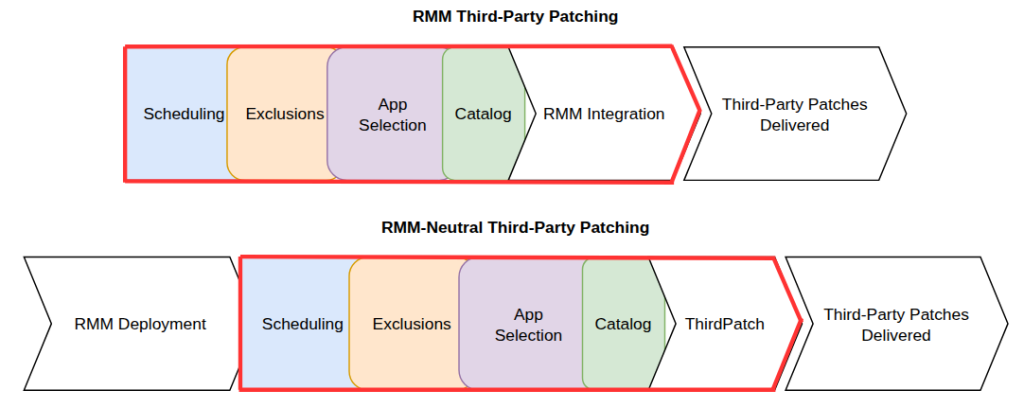
An RMM-neutral third-party patching platform decouples patch management from the RMM itself. The RMM becomes a transport layer, not the control plane.
This separation creates real operational leverage:
-
- Switch RMMs without rebuilding patch workflows.
-
- Maintain consistent third-party patching policies across environments.
-
- Reduce migration risk during M&A transitions.
-
- Avoid being forced into feature bundles you don’t actually want.
In other words, your patching strategy survives vendor changes.
Implementation: How ThirdPatch Fits In
ThirdPatch was explicitly built to solve this problem. It’s RMM-neutral by design. It works with any RMM, rather than being embedded inside one.
That means:
-
- Your patching logic exists independently.
-
- Your workflows aren’t tied to a specific vendor’s scripting engine.
-
- Your third-party patch catalog isn’t locked behind a single ecosystem.
If you decide to move from one RMM to another, your third-party patching layer remains intact. You’re not rebuilding from scratch; you’re simply reconnecting to a different management tool.
That’s a fundamentally different architectural model.
Instead of:
RMM → Third-Party Patching
You get:
Any RMM → ThirdPatch → Third-Party Patching
That paradigm shift matters.
The Strategic Advantage
Most MSPs don’t consider RMM neutrality until they’re forced to migrate.
By then, the pain is already real.
Decoupling third-party patching from your RMM gives you:
-
- Negotiation leverage with vendors
-
- Lower switching costs
-
- Operational continuity during transitions
-
- Long-term architectural flexibility
And in an industry where consolidation and vendor changes are constant, flexibility is resilience.
Want to see what an RMM-neutral third-party patching tool can do for your MSP? Start your 30-day free trial.
